


Blog / Tips & Tricks

Hybrid vs. Plug-in Hybrid: Which Is Better for San Francisco Drivers?

Hybrid vs. PHEV for SF Drivers

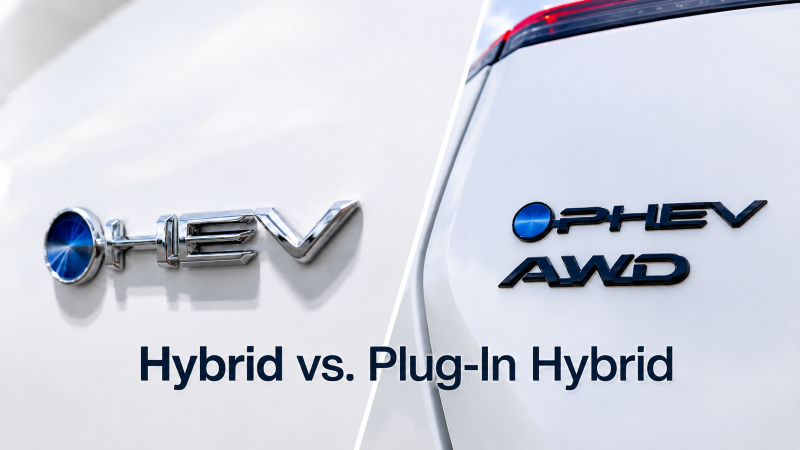
For San Francisco drivers considering their next Toyota, choosing between a hybrid and a plug-in hybrid can be just as important as choosing the model itself.

Both can reduce fuel consumption compared with a traditional gas-only vehicle, but they fit different driving habits. Your daily mileage, access to charging, parking situation, and how often you leave the city can all affect which option makes more sense.

Here are some things to consider.

What's the Difference Between a Hybrid and a Plug-in Hybrid?

A traditional hybrid combines a gasoline engine with an electric motor and battery. The vehicle manages the two power sources automatically, and the battery recharges while you drive through regenerative braking and the gasoline engine.

You don't need to plug it in.

A plug-in hybrid, or PHEV, uses a larger battery that can be charged from an external power source. That allows the vehicle to complete some trips using electricity before switching to operate like a hybrid once the battery's electric range has been used.

The basic decision is therefore simple:

Hybrid: No charging or plugging-in required.

Plug-in hybrid: Gives you an opportunity to drive on electricity, but access to charging becomes more valuable.

When a Hybrid Makes Sense in San Francisco

For many city residents, a conventional hybrid offers one major advantage: simplicity.

If you street park every day, live in an apartment without dedicated charging, or routinely use different parking garages, a hybrid lets you benefit from fuel savings without changing the way you refuel.

That can make hybrids especially practical for drivers who regularly travel between neighborhoods in the city or commute around the Bay Area but don't have reliable access to an outlet or charging station at home.

Stop-and-go city driving is also where hybrid systems can be particularly useful because regenerative braking captures and stores energy as the vehicle slows.

For many San Francisco car shoppers, the ability to simply get in and drive without thinking about charging may outweigh the additional electric capability of a plug-in hybrid.

When a Plug-in Hybrid May Be the Better Choice

A plug-in hybrid becomes a much more compelling option when you have reliable access to charging.

If you have access to a charger at home, at work, or somewhere you visit regularly, many shorter trips may be completed primarily using electricity.

That can be especially attractive in San Francisco, where daily errands and neighborhood trips often involve relatively short distances.

A plug-in hybrid can also provide flexibility that a fully electric vehicle does not. When you leave San Francisco for a longer weekend trip, the gasoline engine remains available after the battery's electric driving range has been used.

For someone who wants electric driving around the city but frequently drives up to Marin, down the Peninsula, to Lake Tahoe, down to LA, or other destinations around California, that flexibility can be appealing.

What If You Live in an Apartment?

This is one of the most important questions for San Francisco car shoppers.

If your building doesn't offer charging and you don't have a dependable charging option nearby, buying a plug-in hybrid simply because it has an electric driving mode may not provide its full benefit.

You can still drive a plug-in hybrid without charging it every day, but the ownership experience makes the most sense when you can regularly recharge the battery.

In that situation, a traditional hybrid may be the easier choice.

If your apartment or workplace does provide charging, however, the calculation changes considerably.

Think About Your Actual Weekly Driving

Instead of starting with fuel economy numbers alone, think about what your typical week looks like.

Ask yourself:

  • How many miles do I usually drive each day?
  • Do I have a consistent place to charge?
  • Is most of my driving inside San Francisco?
  • Do I regularly commute around the Bay Area?
  • How often do I take longer weekend trips?
  • Do I want the simplest possible ownership experience, or do I want to maximize electric driving?

Those questions usually make the decision much clearer.

The 2026 Toyota RAV4 Is a Good Example

The 2026 Toyota RAV4 illustrates how Toyota's electrified lineup is changing. The RAV4 is now only available in Hybrid or Plug-in Hybrid powertrains, giving SUV shoppers two different ways to add electrification without moving to a fully electric vehicle.

For a San Francisco driver without convenient charging, the 2026 RAV4 may offer the easier ownership experience.

For someone who can charge regularly and wants to complete more local driving on electricity, the RAV4 Plug-in Hybrid may be worth considering.

Neither answer is automatically right for everyone.

Find the Right Toyota for the Way You Drive

The best way to choose between a hybrid and plug-in hybrid is to match the vehicle to your actual routine.

At San Francisco Toyota, our team can help you compare Toyota hybrid and plug-in hybrid options based on your commute, parking situation, charging access, passenger needs, and the kinds of trips you make around San Francisco and the Bay Area.

Browse our current Toyota inventory, begin the purchase journey on SmartPath, or visit San Francisco Toyota at 3800 Geary Blvd. or 1701 Van Ness Ave. to compare your options and test drive both in person.
Posted in:

Related Posts

Should you drive a RAV4 on a low tank of gas?

How long can you drive a Toyota RAV4 on empty? We have all probably had that little bit of panic that ensues when the low fuel light appears on the dashboard to signal that we are almost out of gas. That panic is particularly intense if you aren’t anywhere near a gas station or are in the middle of a busy day and can’t find time to make that pit stop. Whether you’re on your way to San Francisco Toyota or heading to a movie, it isn’t always convenient to make that stop. That being said, it does remain possible to drive for a bit in most cars even when the fuel gauge is already down about as far as it can go, though not for too long. We wanted to talk about one vehicle in particular—the Toyota RAV4. So, how long can you drive a Toyota RAV4 on empty? Read ahead for our thoughts. more Toyota RAV4 estimated driving range with the fuel light on Not all vehicles are made the same when it comes to how far they can drive when the fuel light is on. That’s because of a number of factors, such as the specific level of fuel it takes to trigger the warning, the size and weight of the vehicle, your driving style, and many other factors. So, these numbers we’re throwing out here are estimates and are in no way a guarantee that they’ll work for you. Generally speaking, there seems to be a consensus that a RAV4 can go somewhere in the vicinity of 35 to 40 miles once the fuel light turns on. That is just an average based primarily on anecdotal evidence, so please understand that you could potentially achieve a greater distance or a shorter distance. We recommend fueling up as soon as you can once that low fuel indicator appears. Driving on empty can be dangerous. Not only could you find yourself stranded on the side of the road in the middle of nowhere, but you could also sputter out in the middle of a busy highway or other traffic. Plus, running on such low fuel, especially if you do so often, can cause damage to the fuel pump and other components, leading to bigger headaches and costlier issues with your RAV4 than you would have had if you’d made that fuel stop. Please always be mindful of how much fuel you have available for your drive and make sure you will be able to safely reach your destination. How far can you drive a Toyota Camry on empty?

Watch a video explaining what differentials on a vehicle can do

How does a differential on a car work? While perusing our many model research pages or watching different videos going over all of the exciting features offered by new Toyota models, you may see mentions of differentials. Limited slip differential, locking differential, and so on. What exactly is a differential? How does a differential on a car work? Toyota has created a very informative video to demonstrate what this does and why it is important. Take a look! more Vehicle differentials explained by Toyota As you can see from the video here, there are a couple of differentials, and they make sure to perform a very important task to help ensure you are getting a smooth ride at all turns. Toyota has done an exceptional job of explaining the mechanics of differentials, and it’s some great Automotive 101! How do you use Toyota Destination Assist?

Should you get service based on time vs based on mileage?

Time-based car service vs mileage-based vehicle service You often see warranties or service information giving you time and mileage suggestions or requirements, such as “three years or 36,000 miles.” When it comes to routine maintenance, guidance is often given about how many miles should be driven between oil changes, generally arriving somewhere between 3,000 miles and 10,000 miles (though the specific number is up to the manufacturer, so it is always best to check your owner’s manual). But what about situations where you are hardly driving, like what has been happening the past year for many people? What if months and months have gone by since your last oil change but you haven’t come close to the mileage amounts needed for that service? We want to take a closer look at time-based car service vs mileage-based vehicle service. more How to take care of your car during quarantine Should you get an oil change even if you didn’t hit the necessary mileage? In short, yes, there are instances where you should get your oil changed and your vehicle serviced even if you did not hit the normally required mileage. It is recommended that, even if you do not drive often, you should get your oil changed at least twice a year to keep everything running smoothly. So, if you’ve hardly driven at all in six months or longer and haven’t hit that 3,000 or 5,000 mile threshold, it is still recommended to change your oil anyway. Oil always degrades over time, so the quality of the oil continues to deteriorate as the months progress. No matter how often you are driving, the oil quality will only go down over time, and even if you do not drive often, you need to be sure that you have high-quality oil working its magic. Other routine services to consider You don’t want to let too much time go between service appointments because, in addition to getting fresh oil for the engine, other items might need attention. Even if you haven’t driven the necessary amount of mileage, the time elapsed is important to consider for such things as tire rotations, battery checks, brake service, and really the whole kit and kaboodle. It is vital to stay on top of your vehicle’s needs because, while you may not drive it often, you need to be sure it will work as it is supposed to when you do take it out for a spin! San Francisco Toyota has two service center locations!